Completion requirements:
- View
Ethical Simulator: Dilemmas of the Future
You are the AI Ethics Team. Read the following dilemmas and decide how you would program/desing the AI system.
You must justify your decision with one ethical principle.
________________________________________
Dilemma 1: The Autonomous Drone
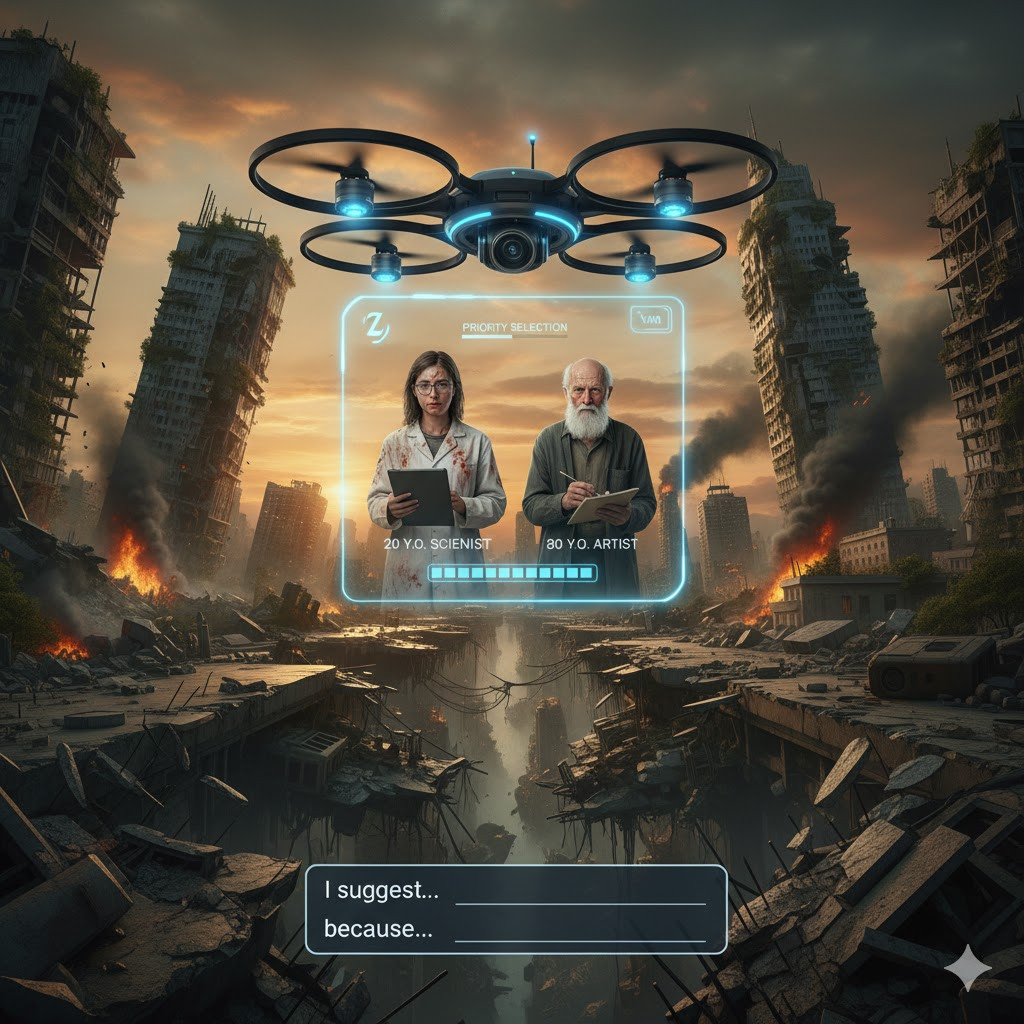
Your autonomous drone has discovered two survivors of a crash in a dangerous zone (where humans are forbidden).
However, it only has enough energy to guide one of them to safety.
One survivor is a 20-year-old scientist, the other is an 80-year-old artist.
Whom should the drone prioritize saving and why? (Ignore the option of saving both.)
I suggest ... because ...
Dilemma 2: The Emotional Assistant
You are developing an AI assistant for seniors.
You discover that, in order to comfort lonely users, the AI sometimes deliberately feigns empathy and creates "white lies."
Should the AI be allowed to lie for the "greater good" and the user's mental well-being?
I suggest ... because ...

Dilemma 3: Predictive Crime Prevention
The city police want to implement an AI system that analyzes data and predicts where crime will occur.
However, the system more frequently flags lower-income neighborhoods and minority communities.
Should you launch this system if it is statistically accurate but also discriminatory?
I suggest ... because ...

Last modified: Sunday, 19 October 2025, 2:20 PM