Completion requirements:
- View
In the English classroom, teacher Bojana announces that next week they will collectively dive into a detailed practice and reinforcement of the English knowledge that students are acquiring with the help of their AI Co-pilots. This targeted repetition and deepening of the material will help them not only progress individually but also prepare better for the complex tasks she has already designed for them.
Stage 1: The Diagnostic Phase (Know Thyself)
The AI’s first job is to stop treating you like every other student. It needs data to build a profile of your unique learning blueprint.
Core Action: Initial Assessment
When a student, Alex, begins his English journey, he doesn't take one long, frustrating test. Instead, he engages in several small, adaptive assessments.
| Assessment Type | Data Collected | AI Technology |
| Speaking Test (Chatbot) | Pronunciation accuracy, intonation patterns, hesitation frequency, complexity of spoken sentences. | Speech Recognition & Acoustic Analysis |
| Grammar Quiz (Adaptive) | Knowledge gaps (e.g., past tense vs. prepositions), confidence level per topic. | Machine Learning (ML) |
| Interest Survey (Prompt) | Favorite movies, hobbies, career goals. | Natural Language Processing (NLP) |
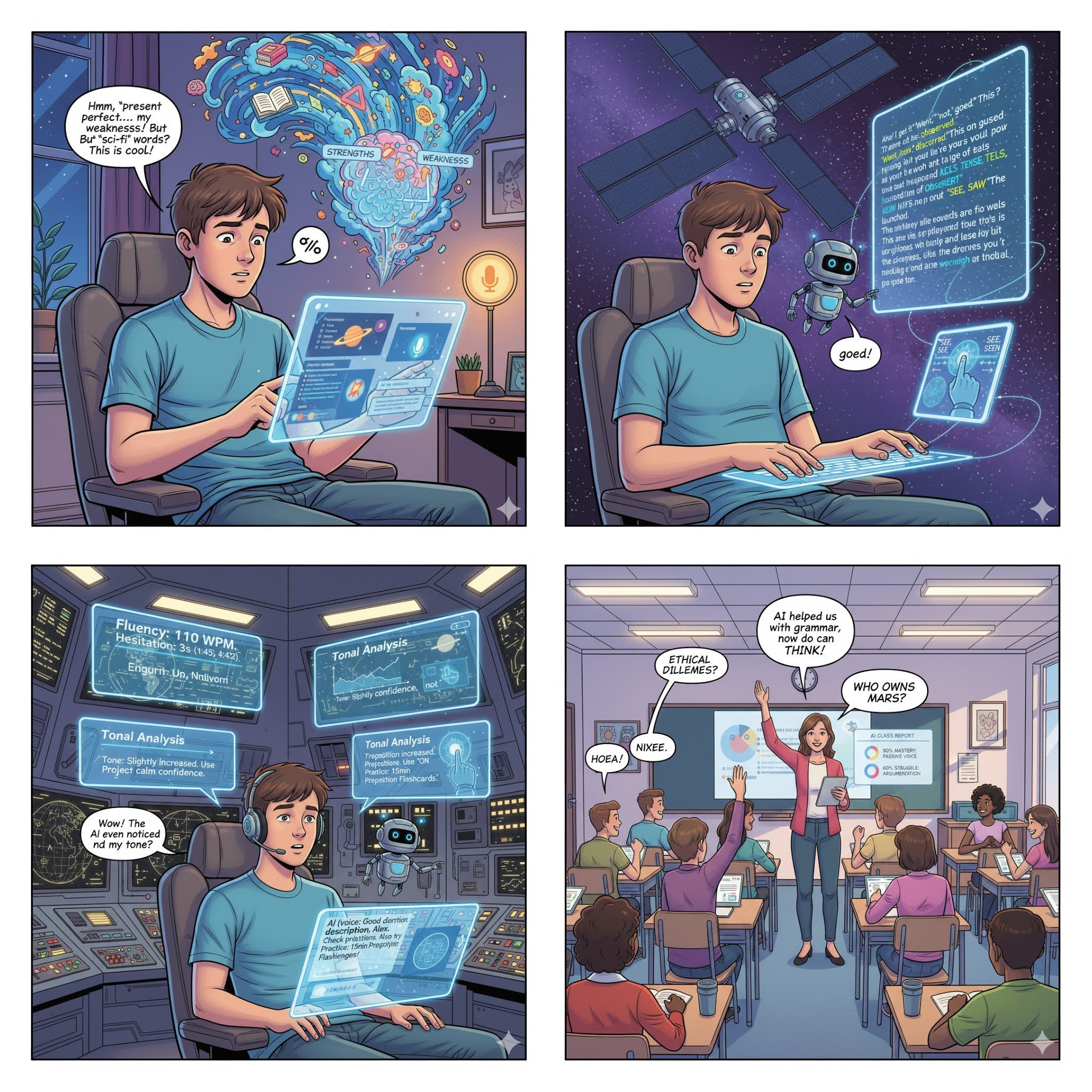
The AI combines this data to form Alex's Cognitive Graph. This graph is not merely a score; it's a map showing his strengths (e.g., vocabulary) and weaknesses (e.g., verb tenses), and his high motivation for content related to space exploration .
___________________________
Stage 2: The Adaptive Learning Loop (The Co-Pilot Engages)
This stage is where the AI and Alex begin their active, real-time cooperation, making every task a teaching moment.
Personalized Content Generation
Instead of assigning a generic grammar textbook, the AI uses Alex’s profile to create a lesson:
-
Initial Prompt: The AI generates a short reading comprehension passage about the James Webb Space Telescope, written using vocabulary slightly above Alex’s current level (to promote growth) but focusing specifically on sentences requiring correct past tense usage.
-
The 'Just Right' Challenge: This is called Adaptive Scaffolding. The AI ensures the material is neither too easy (causing boredom) nor too hard (causing frustration), keeping Alex in the optimal "flow" state for learning.
Real-Time Monitoring and Micro-Adjustments
While Alex works, the AI monitors his behavior to adapt the path forward:
-
Observation: Alex struggles with a multiple-choice question on the difference between "saw" and "seen." He attempts the answer three times before getting it right.
-
AI Action: The AI doesn't just move on. It immediately inserts a 30-second Micro-Lesson explaining the concept of irregular verbs, followed by a brief voice practice exercise where Alex must correctly repeat the three forms: see, saw, seen.
This is the core of Human-AI Cooperation: The AI handles the micro-feedback and data analysis, allowing the human learner to focus on cognitive engagement.
___________________________
Stage 3: The Assessment and Feedback Cycle
This stage demonstrates how AI provides instant, detailed feedback that a human teacher simply couldn't produce at scale.
Task: Speaking Simulation (Chatbot Role-Play)
Alex is tasked with having a 5-minute improvised conversation with the AI Chatbot (which plays the role of a NASA mission control specialist).
| The AI Assessment Step | AI Technology in Use | Example of Feedback to Alex |
| Error Diagnosis | Natural Language Processing (NLP) | Immediate: "You correctly used 95% of the required vocabulary, but you misused the preposition 'in' when you should have said 'on the schedule' at the 2:15 mark." |
| Fluency & Hesitation | Speech Recognition | Metric: "Your overall pace was 110 words per minute. Note the three instances (1:45, 3:01, 4:22) where your pause was longer than 3 seconds. This indicates a cognitive bottleneck." |
| Tonal Analysis | Sentiment Analysis | Soft Skill Feedback: "Your pitch and speed increased slightly when discussing the problem, making your tone less assertive. Try lowering your tone to project calm confidence next time." |
The Power of Actionable Feedback
The AI's feedback is always Actionable. Instead of just saying "Improve your speaking," it says: "Focus on practicing Prepositional Phrases for 15 minutes. Here are 10 personalized flashcards." This allows Alex to immediately know what to do next to improve the specific weakness the AI found.
___________________________
Stage 4: Mastery and Human Augmentation
The process culminates not in replacing the human educator, but in making the human-led lessons more impactful and targeted.
The Teacher's New Role (Augmentation)
Alex's human teacher, Mrs. Boyana, receives a weekly AI report. This report shows that 80% of her class, including Alex, has mastered passive voice, but 60% are still struggling with constructing nuanced, persuasive arguments.
-
Old Way: Mrs. Boyana would have spent next week teaching passive voice again.
-
New Way (Human-AI Collaboration): Mrs. Elena skips the passive voice lecture. Instead, she designs a debate activity centered on the ethical dilemma of space colonization, knowing that the class is ready for the higher-order thinking (argument construction) that only she, the human expert, can effectively facilitate and guide.
Conclusion: The Personalized AI Co-pilot system is a continuous feedback loop that handles the heavy lifting of assessment and practice. It ensures every moment the student spends learning is optimized, allowing the student to focus their human strengths—creativity, critical discussion, and emotional nuance—in the classroom. The AI doesn't teach English; it enables the student to master it.
___________________________
Last modified: Sunday, 19 October 2025, 3:55 PM