Completion requirements:
- View
The integration of Artificial Intelligence (AI) in educational activities represents a unique opportunity to make learning more interactive, personalized, and inclusive. By allowing students to actively participate in knowledge construction—questioning, exploring, and creating—AI transforms the traditional role of the student from a passive recipient of information into an active agent of their own learning.
AI tools, from educational chatbots to assisted writing platforms and scientific simulators, provide diverse experiences that enhance autonomy, critical thinking, and creativity. They also promote inclusion, supporting students with linguistic, visual, auditory, or cognitive difficulties.
However, the success of these activities depends on conscious and guided use: teachers remain essential as mediators, guides, and ensureers of pedagogically appropriate use, while students must use AI critically and responsibly, avoiding overreliance or plagiarism.
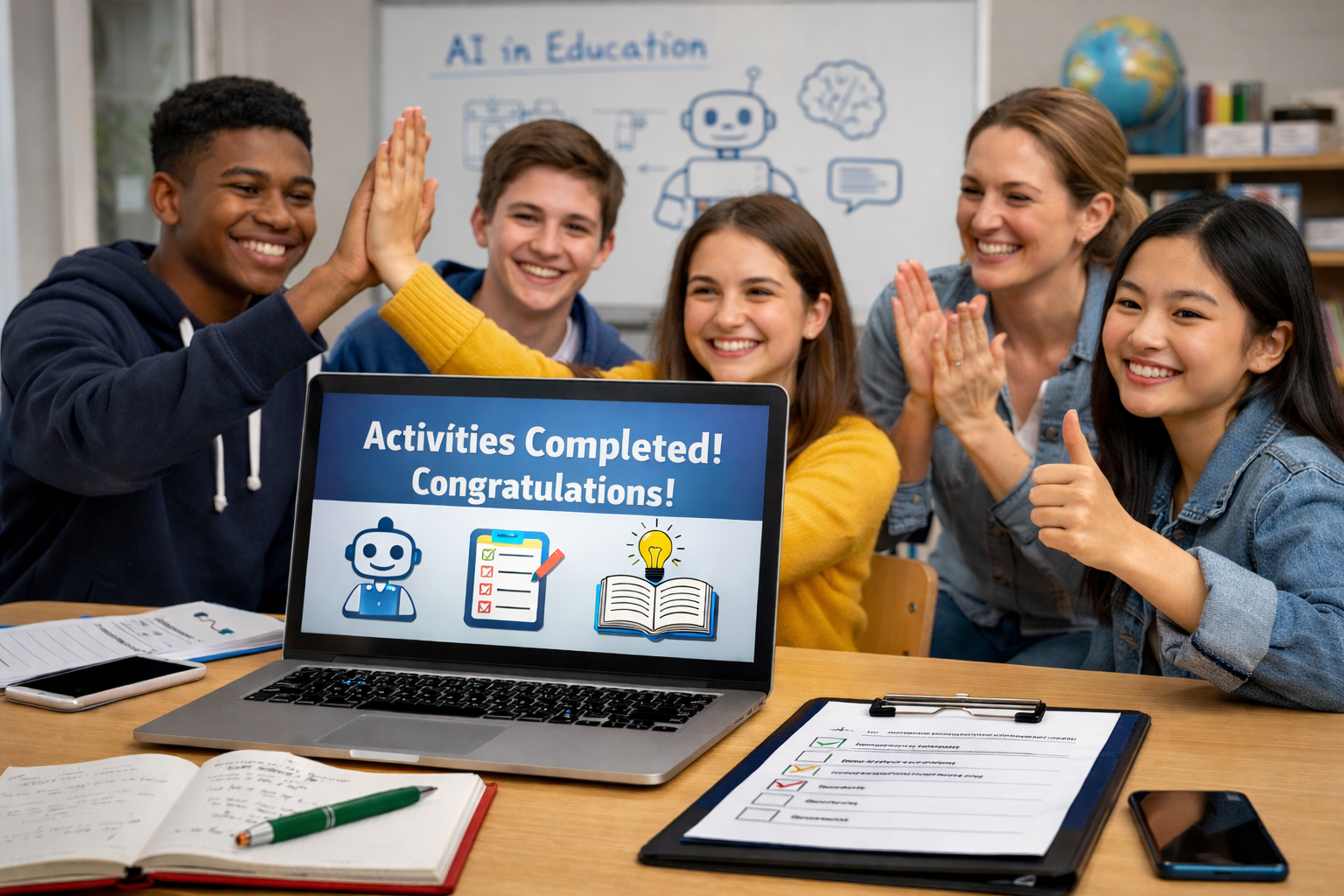
In short, when properly implemented, interactive AI activities do not replace traditional learning but complement it, transforming the classroom into a more dynamic, collaborative space, adapted to the needs of the 21st century.
Last modified: Tuesday, 20 January 2026, 12:56 PM