Building a Responsible AI Future
Introduction: Artificial intelligence (AI) is a powerful tool transforming our world. With its immense potential come serious questions about ethics, regulation, and safety. Like fire, AI can be a great servant but a terrible master if left unchecked. That's why it's crucial for us to consider how we can use AI responsibly and safely.
Activity Goal: To understand the key ethical and regulatory challenges associated with AI and to discuss possible solutions that will help us create a safer and more just future.
Key Challenges to Solve TODAY to Prevent a Future Catastrophe
TOPICS:
-
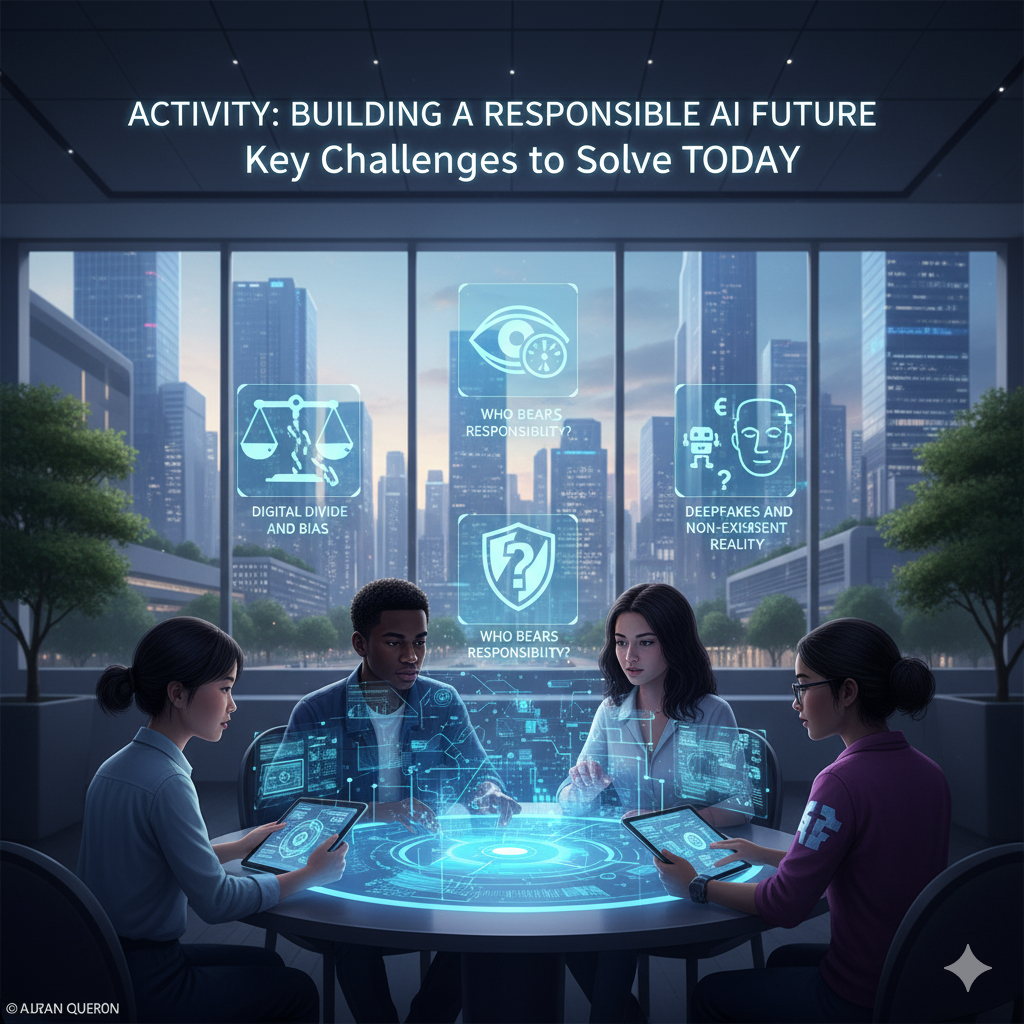
Digital Divide and Bias AI learns from the data we give it. If the data is full of historical biases (e.g., loan approval data dominated by white men), AI will repeat these biases and deepen injustice. The future of AI depends on the ethical data we input.
-
Who Bears Responsibility? If an autonomous car causes an accident, who is at fault? The driver (who wasn't driving)? The manufacturer? The programmer? Or the AI itself? The future demands entirely new laws and a justice system.
-
Deepfakes and Non-Existent Reality Today, generative AI creates texts and images. Tomorrow (if not already today), it will create video and voice that you won't be able to distinguish from reality. What happens when we can't tell what's true? Your key skill: Becoming a master of digital literacy.
-
Job Market: Are Robots Taking Your Job? Yes, AI will replace routine jobs – accountants, translators, operators. But this has happened with every industrial revolution! These changes will open space for new, more human roles. Even the concept of Universal Basic Income (UBI) is being discussed – where the state provides a basic income because robots are taking care of the economy.
For students:
- Divide into Groups: Form small groups (ideally 3-4 students).
-
Choose a Topic: Each group will choose one of the four challenges listed, or your instructor will assign one:
-
Digital Divide and Bias
-
Who Bears Responsibility?
-
Deepfakes and Non-Existent Reality
-
Job Market: Are Robots Taking Your Job?
-
-
Group Discussion (15-20 minutes):
-
Understand the Problem: How does your group understand this challenge? Can you provide your own examples from real life (or what you've heard/read)?
-
Brainstorm Solutions: What are potential solutions to this problem? Who should be responsible for implementing these solutions (government, companies, individuals, international organizations)?
-
Consequences of Inaction: What would happen if we left this problem unresolved? What would be the impacts on society, the economy, or individuals?
-
Personal Stance: How do you feel about this issue? What concerns you most, or conversely, what gives you hope?
-
-
Presentation and Whole-Class Discussion (5-7 minutes per group):
-
Each group will briefly present their chosen challenge and proposed solutions to the rest of the class.
-
A short discussion can follow each presentation, where other groups can ask questions or add their own ideas.
-
-
Conclusion and Reflection:
-
Finally, summarize the main ideas together as a class.
-
Each student can reflect on what role they can play in building a more responsible AI future (e.g., through critical thinking, digital literacy, staying informed).
-
Questions for Reflection after the Activity:
-
What did I learn about AI today that I didn't know before?
-
Which of the challenges seems most urgent to me and why?
-
What steps should we take today to ensure the ethical and safe use of AI in the future?
Completion requirements:
- Submit feedback