Completion requirements:
- View
In this lesson, we will explore some areas of artificial intelligence. The boundaries between them are not strict, and often the techniques used to solve the problems of one area can be helpful in solving the problems of another area. The real power of artificial intelligence will actually be in connecting all areas.
Computer vision
Computer vision is a field of artificial intelligence that deals with the development of algorithms and tools that give computers the ability to understand the visual world like humans. Such are, for example, the tasks of recognizing objects in images, understanding their relationships, recognizing colors and textures, then recognizing movements, actions and their characteristics. As this field is primarily concerned with the analysis of images and videos, we will also get to know some of the most common tasks of this field.
The task of image classification is used to determine what type of object is present in the image. For example, determining whether or not there is a dog in an image is the task of classifying images. Object Detection is the task of locating objects and answering the question of where exactly objects are located in an image. Such, for example, is the task of framing the dog and cat that are in the picture below. The Task of Image Segmentation is used to determine the exact shape of objects that appear in an image. So, now, the finer separation of the contours of the dog and cat in the third image is an example of segmentation.
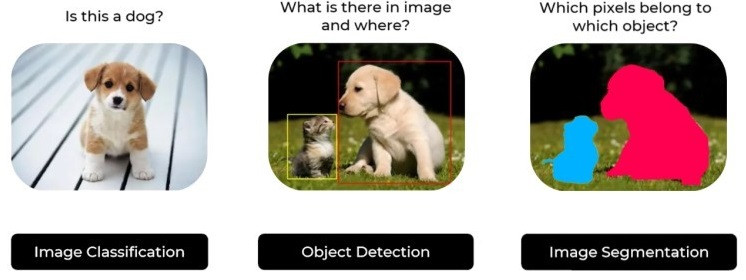
The Three Primary Tasks of Computer Vision in Working with Images
All these tasks are very applicable in many disciplines such as autonomous driving, medical image analysis or satellite image analysis, and allow us to search and organize images more easily.
What tasks do the following problems fall for:
To find out if there is a pedestrian in the picture.
separating the contours of traffic lights, pavement and pedestrians in the picture,
Do you want to know where the sign is in the picture?
When it comes to video processing, the most common tasks are object tracking, action recognition, and positioning.
The Task of Object Tracking, as the name suggests, allows you to track objects in a video in real time. For example, tracking a neighboring car while driving autonomously and tracking a player's movements during a match are examples of object tracking.
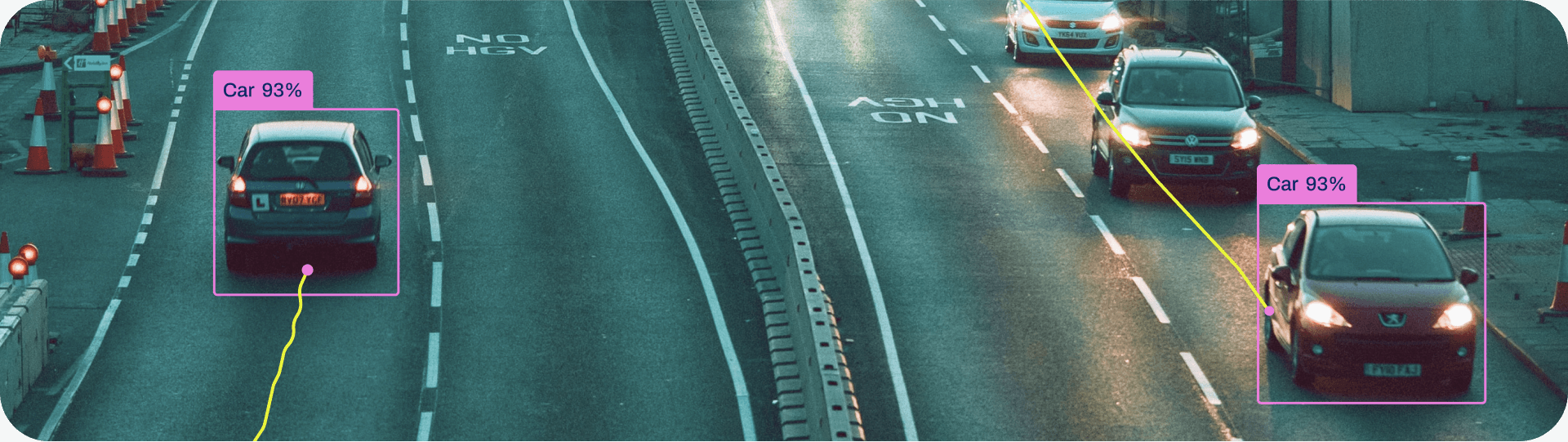
Object tracking
(image taken from https://docs.ultralytics.com/modes/track/ )
The action recognition task is the ability to recognize and name an action that is present in a video, for example, jumping into the water or closing a window. These tasks help us to better understand video content and search for it more efficiently.
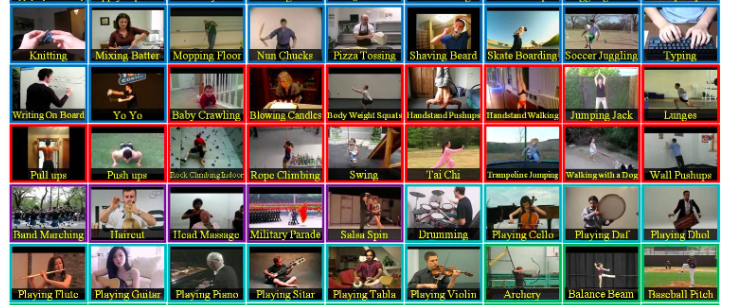
Examples of recognizing actions in videos
Pose estimation is a task that deals with recognizing the figures of people in videos in real time and extracting all the key points of their skeleton. These are the most common choroids of the eyes, nose, mouth, shoulders, elbows, waist, hands, knees and feet. These tasks help us with interactive animations, augmented reality modeling, and a variety of other applications.
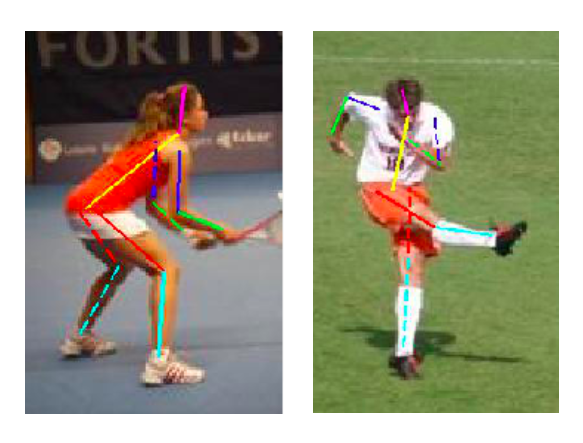
Object Position Recognition Task: Images from the Leeds Sports Pose Dataset
What task do we need to solve in order to:
analyze whether we are sitting correctly,
recognize the exit to the pet's yard,
Do you want to keep track of the customer's movements in the store?
Later, we'll get to the datasets used in computer vision and convolutional network tasks, a special type of neural network used in image and video processing tasks.
Natural Language Processing
Natural Language Processing (NLP ) is a field of artificial intelligence that deals with tasks related to the understanding and generation of natural language. As we know, there are over 7,000 languages, and each of them has its own peculiarities in terms of vocabulary, grammatical rules and meanings. Some common tasks encountered in natural language processing will be described below.
Just like in the image classification tasks, in the text classification tasks we try to conclude whether the text belongs to a category or not. For example, is it a newspaper article on the subject of sports, is it written in Spanish, is it positive, i.e. contains some complimentary comment, whether it is true or false and the like.
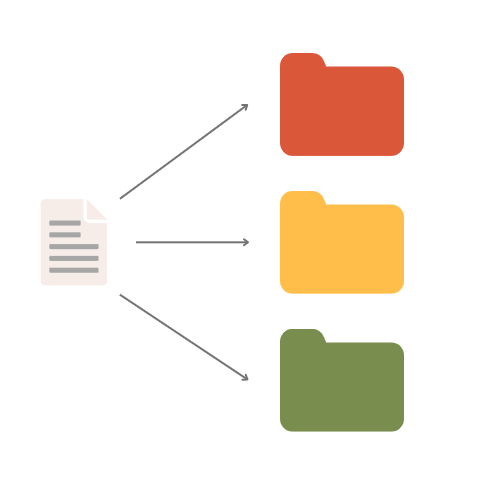
Text classification
Named Entity Recognition is a task related to the recognition of some parts of the text that are relevant for its further analysis. These are usually the names of the people who appear in it, dates, geolocation names or in some professional texts, for example in the field of medicine, symptoms or names of diseases. By a single name, these parts of the text are called entities.
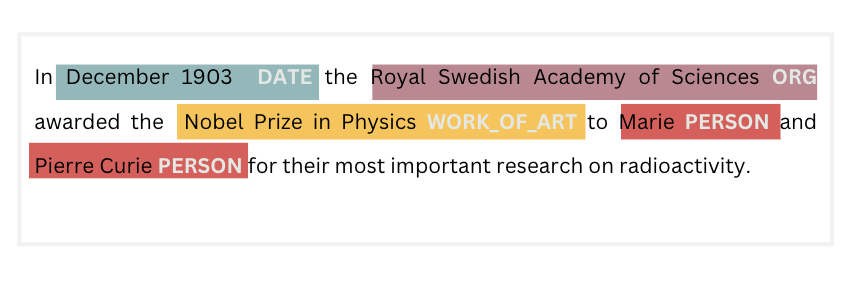
Example of tagging named entities
The Task of Translation Machine is to develop tools that allow us to translate content from one language into the content of another language. We will agree that this task is the basis for successful communication and the availability of information, but also that it is complicated because each language and each culture that the language represents has its own peculiarities such as phrases, idioms, slang or sarcasm that are very challenging to translate (how to translate a barren brain to pasture? ).
Question-answering systems deal with the question of how to find a concrete answer to a given question. They are generalizations of classic information retrieval systems and allow us to get the information we need more easily.
Summarizing all important information from a number of different sources is known as a summarization task. Just like in the previous task, the summaries that come with the summarization tasks should make it easier for us to go through a larger amount of content or remind us of important information and details of the content we have read.
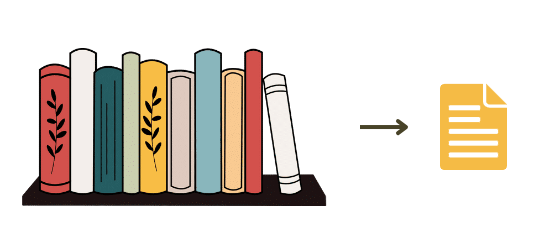
Summarization
In addition to tasks related to text and textual content, natural language processing also deals with speech analysis. There are two tasks in particular: speech-to-text and vice versa, text-to-speech. These two groups of tasks are especially important for the development of personal assistants, programs such as Siri , Cortana, or Alexa , that can understand voice messages and perform a requested task accordingly, for example, set an alarm or call someone from the phonebook.
What tasks do the following problems fall for:
Extracting the name of the organization in the text,
Finding out who is the author of the book,
What is the meaning of the word Netizen ?
Generative Artificial Intelligence
Generative Artificial Intelligence (AGI) is a field of artificial intelligence that deals with the generation of content such as images, text, audio, or video. Over the past few years, the breakthroughs in this field have been impressive.
ChatGPT is a program that has made a breakthrough in the field of generating text content. He, in accordance with the user's instructions, the so-called prompts, can generate appropriate text content. It should be remembered that texts generated in this way do not have to be absolutely accurate, they may contain incorrect data, fabricated references or offensive content. Therefore, before use, you should check everything that the program has generated. If you create an account at chat.openai.com , you can try for yourself how the ChatGPT program works. Behind the ChatGPT program is the OpenAI community.
The StableDiffusion program , unlike ChatGPT , which generates text, generates images based on instructions. For example, all the images listed below were generated by this program. It is open source and can be downloaded from the official GitHub repository with the accompanying code. You can test the model itself at https://stablediffusionweb.com/ . Keep in mind that this service is used by a large number of people for free and is sometimes not available. The name of the program itself is a popular technique used in this field.

Examples of images generated by StableDiffusion
Often, when generating images, the desired style of the new image can also be selected. This technique is known as style transfer . style transfer ). You can see an example in the picture below.
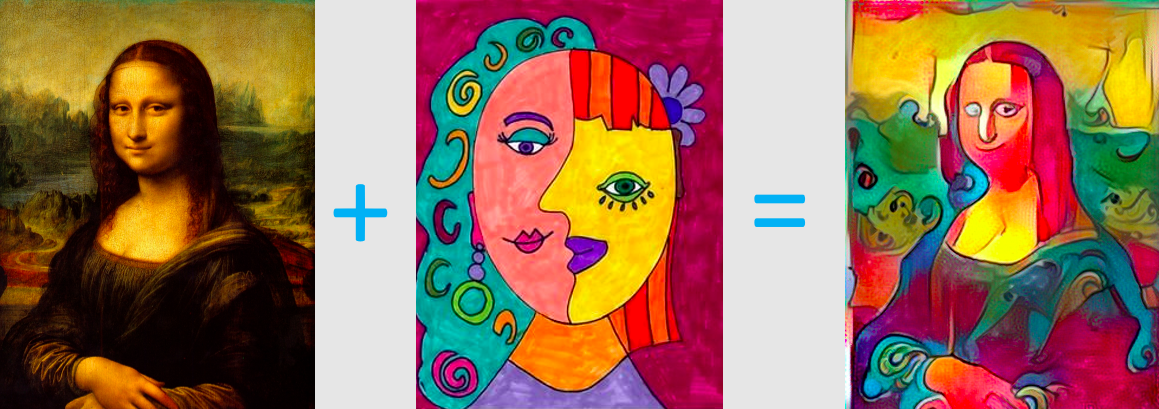
In addition to images and text, artificial intelligence can also generate audio content. At this link, you can test Meta's MusicGen program , by describing in words what kind of music you want to generate and possibly leaving an example for style transfer. Then you can listen to your own content. You can also try with programs that perform style transfer when generating a voice (mimic another person's voice) or compose music yourself based on the what they have already "heard" in the data. One such project is Magenta. A link https://magenta.github.io/listen-to-transformer/ will take you to it .
Ask ChatGPT to create a quiz with questions about artificial intelligence, and then see how many questions you can answer.
Try giving instructions to StableDiffusion or Dalle-mini that will generate an image like this:

OpenAI's DALL-E program also generates images based on user guidelines. The dalle-mini program is a publicly available version of this program. It is available at https://huggingface.co/spaces/dalle-mini/dalle-mini .
Playing games
One of the first tasks in which artificial intelligence has been tried is the game of chess. With its victory over Grandmaster Garry Kasparov, this area of research has received a lot of sympathy and support from the side of artificial intelligence. Although they have a precise set of instructions and rules, the games are characterized by the property of a combinatorial explosion - a large number of possible choices of actions after a certain number of steps. This further means that the games do not allow for finding solutions by applying common programming techniques in some within a reasonable time. In addition to the game of chess, artificial intelligence has also become famous in the game of go with the AlphaGo program, then playing Atari video games and strategies such as Dota, Starcraft and others. At the end of the course, you will learn more about the field called reinforcement learning, which is actively applied in this area.
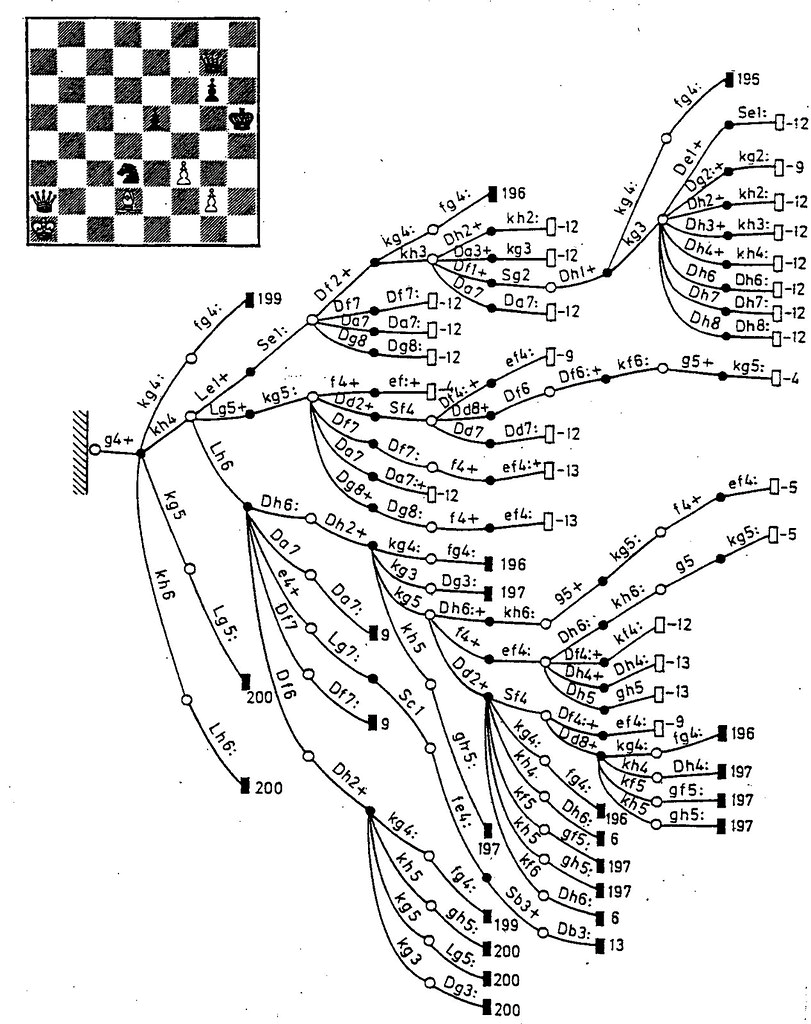
Combinatorial explosion in the game of chess
Check to see if the game you love uses artificial intelligence in some of its segments.
Robotics
Artificial intelligence often needs to improve the behaviors and capabilities of physical objects such as robots, industrial machines, cars, drones, home appliances or medical devices. Information about the world reaches these objects through voice instructions, camera recordings, or sensor measurements, and their task is to process them and transform them into decisions. The role of artificial intelligence in this sphere is to improve the capabilities of objects and help them adopt intelligent behavior.
Last modified: Friday, 26 December 2025, 10:30 PM