Completion requirements:
- View
The Turing test, proposed by Alan Turing (1950), was designed as a thought experiment that would sidestep the philosophical vagueness of the question “Can a machine think?” A computer passes the test if a human interrogator, after posing some written questions, cannot tell whether the written responses come from a person or from a computer. Chapter 28 discusses the details of the test and whether a computer would really be intelligent if it passed. For now, we note that programming a computer to pass a rigorously applied test provides plenty to work on. The computer would need the following capabilities:
- natural language processing to communicate successfully in a human language;
- knowledge representation to store what it knows or hears;
- automated reasoning to answer questions and to draw new conclusions;
- machine learning to adapt to new circumstances and to detect and extrapolate patterns.
Turing viewed the physical simulation of a person as unnecessary to demonstrate intelligence. However, other researchers have proposed a total Turing test, which requires interaction with objects and people in the real world. To pass the total Turing test, a robot will need
- computer vision and speech recognition to perceive the world;
- robotics to manipulate objects and move about.
These six disciplines compose most of AI. Yet AI researchers have devoted little effort to passing the Turing test, believing that it is more important to study the underlying principles of intelligence. The quest for “artificial flight” succeeded when engineers and inventors stopped imitating birds and started using wind tunnels and learning about aerodynamics. Aeronautical engineering texts do not define the goal of their field as making “machines that fly so exactly like pigeons that they can fool even other pigeons.”
Can a machine think?
Interestingly, the development of artificial intelligence has been fraught with obstacles.
The question is, "Can a machine think?" In 1950, English mathematician Alan Turing signaled the beginning of the development of the field now known as artificial intelligence. A few years after this great idea, in 1956, eminent scientists John McCarthy, Marvin Minsky, Nathaniel Rochester and Claude Shannon gathered for a conference in Dartmouth, which lasted as long as a month, with the desire to define research goals and protocols in this field. It was then that it was given its official name and for the first time actually presented as an artificial intelligence.
At the time of the advent of artificial intelligence, computers were very different than they are today. They were much smaller in capacity and speed, and much higher in price. Therefore, research in this area required different design solutions, and depended on official support and stable sources of funding.
In the first wave of the development of artificial intelligence, which lasted until the beginning of the seventies of the 20th century, many interesting programs appeared. The first among them was the program Logic Theorist , written in 1956, which examined the capacities of mathematical logic and deriving conclusions. This program managed to prove 38 of the first 52 theorems listed in the famous book Principles of Mathematics . There is also the ELIZA program, which could simulate a conversation with users by following simple rules and constructions in English. The motivation for research in the field of communication came from Alan Turing's proposal to declare intelligent machines that can communicate in such a way that they do not give the impression that a person is talking to a machine. This test is now known as the Turing test.
In the period up to the beginning of the 1970s, many ideas emerged that would later be used for breakthroughs in modern artificial intelligence. One such is the idea of the perceptron, the basis of today's neural networks, introduced in 1957 by Frank Rosenblatt. In the optimistic statements of this researcher, the perceptron had the power to learn, make decisions and translate languages, but it took a long time to confirm this.
Due to the lack of funding, the first wave of artificial intelligence development was followed by the so-called first winter of artificial intelligence. This status is partly due to ambitious projects whose results have been lacking due to limited computer capacities and a lack of available data.
One of the interesting and stimulating events in the history of artificial intelligence occurred in 1997 when IBM's DeepBlue system managed to beat the chess game of world grandmaster Garry Kasparov. The DeepBlue system is a representative of the class of so-called expert systems (eng. Expert systems ), systems that, on the basis of a database containing a multitude of rules of the form if-then, by applying logical rules, could imitate the reasoning of domain experts and give a correct result. Google's DeepMind's AlphaGo system had a similar effect on the development of artificial intelligence almost 20 years later, in 2016, when it defeated world champion Lee Sedol in the game of Go.
In 2011, the ability of machines to find the answer to a question posed in English was demonstrated by IBM's Watson system in the Jeopardy quiz! . Watson defeated its two opponents, winners of previous editions of the quiz, by giving the fastest correct answers to the questions asked. Sources who wrote about this event stated that Watson was able to process 500 GB of content per second, i.e. about a million books.
On the other hand, the capacity of machines to recognize and distinguish objects in images was demonstrated in 2012 by the Google X team, who created a program that can recognize cats in images. This program saw over 10 million images in 3 days and learned to recognize cats. To date, the capacity of recognition systems has been greatly improved and in many applications such systems give more accurate answers than most people. In the image below you can see the development trend systems for handwritten text recognition, speech recognition, image recognition, and two more recent results with a remarkable growth in capabilities are related to language comprehension tasks.
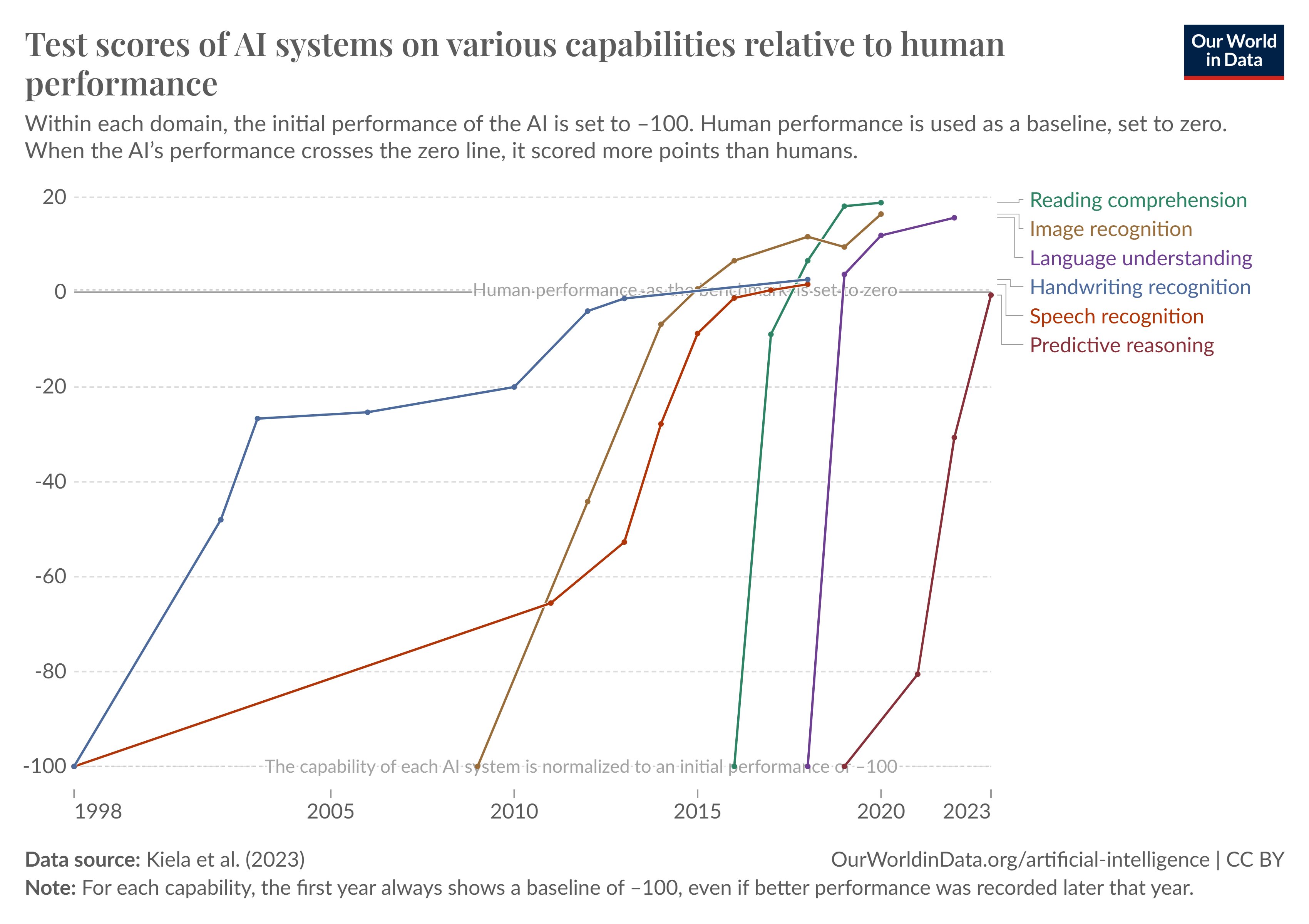
The image is taken from https://ourworldindata.org/brief-history-of-ai
These achievements were also a prelude to a far brighter continuation of the development of artificial intelligence, both because of the availability of the Internet, the web andmore data, as well as because of computers whose processing power is incomparably greater than computers in the 1950s. This has also led to a paradigm shift that has been dominant in the field and the transition from logic-based systems to statistics-based systems.
The story of the development of artificial intelligence is also related to robots. Not only in science fiction novels and movies, but also when it comes to the appearance of real robots. In 1950, the American scientist Claude Shannon designed a mouse that could find its way and get out of the maze. In the spirit of Greek mythology, the mouse was named Theseus. In 1966, a team of scientists from the Stanford Research Institute began work on the development of the Shakey robot , the first robot capable of moving and inferring about the environment. The first autonomous vehicle ALVINN (acronym for Autonomous Land Vehicle In a Neural Network ), worked on by a team of researchers from Carnegie Mellon University, was constructed in 1989 and successfully covered 145 kilometers traveling at a speed of 110 kilometers per hour among other cars.
Last modified: Saturday, 18 January 2025, 2:06 PM